Patients were ineligible for or had declined cisplatin-based chemotherapy. Patients in the comparator arm had a radical cystectomy (surgery to remove the bladder) with or without approved adjuvant treatment.
Perioperative IMFINZI plus IMJUDO® (tremelimumab-actl) in combination with neoadjuvant EV demonstrated a statistically significant and clinically meaningful improvement in EFS and a favorable trend for OS; however, the OS data were not statistically significant at this planned interim analysis and will be formally reassessed at a subsequent analysis.
Approximately one in four patients with bladder cancer has muscle-invasive disease, where the tumor invades the muscle wall of the bladder, without distant metastases.1,2 As many as 50% of patients are ineligible for cisplatin-based chemotherapy due to impaired renal function or comorbidities.3,4 The standard treatment for these patients has historically been radical cystectomy alone but, despite undergoing this major surgery, patients experience high rates of recurrence and have a poor prognosis.3-5
Thomas Powles, MD, Professor, Chair of Barts Cancer Centre (QMUL), London, UK, and International Coordinating Investigator for the trial, said: “Up to half of patients with muscle-invasive bladder cancer are not eligible for cisplatin and face high rates of disease recurrence, even after having their bladder removed, leaving a significant need for new effective and well-tolerated treatments. The VOLGA results show that perioperative durvalumab significantly extends event-free survival and overall survival when combined with neoadjuvant enfortumab vedotin, with a manageable safety profile, compared to surgery for patients in this curative-intent setting.”
Susan Galbraith, Executive Vice President, Oncology Haematology R&D, AstraZeneca, said: “This interim analysis from the VOLGA trial highlights the benefit of perioperative IMFINZI with neoadjuvant enfortumab vedotin compared to surgery, a novel regimen that optimizes treatment options for patients. Together with NIAGARA and POTOMAC, VOLGA is our third positive readout in bladder cancer, setting a strong foundation for IMFINZI as the immunotherapy backbone in this early-stage, curative-intent setting.”
The safety and tolerability of IMFINZI with or without IMJUDO plus EV was consistent with the known safety profiles of the individual medicines, with no new safety signals identified. These data will be presented at a forthcoming medical meeting and shared with global regulatory authorities.
IMFINZI is approved in over 40 countries for patients with cisplatin-eligible MIBC, based on the NIAGARA Phase III trial. Additionally, IMFINZI added to Bacillus Calmette-Guérin therapy met the primary endpoint of disease-free survival for patients with high-risk non-muscle-invasive bladder cancer in the POTOMAC Phase III trial and is currently under review in the US, European Union (EU), Japan and several other countries. IMFINZI is also being investigated in locally advanced or metastatic disease in the NILE Phase III trial.
IMPORTANT SAFETY INFORMATION
There are no contraindications for IMFINZI® (durvalumab) or IMJUDO® (tremelimumab-actl).
Severe and Fatal Immune-Mediated Adverse Reactions
Important immune-mediated adverse reactions listed under Warnings and Precautions may not include all possible severe and fatal immune-mediated reactions. Immune-mediated adverse reactions, which may be severe or fatal, can occur in any organ system or tissue. Immune-mediated adverse reactions can occur at any time after starting treatment or after discontinuation. Monitor patients closely for symptoms and signs that may be clinical manifestations of underlying immune-mediated adverse reactions. Evaluate clinical chemistries including liver enzymes, creatinine, adrenocorticotropic hormone (ACTH) level, and thyroid function at baseline and before each dose. In cases of suspected immune-mediated adverse reactions, initiate appropriate workup to exclude alternative etiologies, including infection. Institute medical management promptly, including specialty consultation as appropriate. Withhold or permanently discontinue IMFINZI and IMJUDO depending on severity. See USPI Dosing and Administration for specific details. In general, if IMFINZI and IMJUDO requires interruption or discontinuation, administer systemic corticosteroid therapy (1 mg to 2 mg/kg/day prednisone or equivalent) until improvement to Grade 1 or less. Upon improvement to Grade 1 or less, initiate corticosteroid taper and continue to taper over at least 1 month. Consider administration of other systemic immunosuppressants in patients whose immune-mediated adverse reactions are not controlled with corticosteroid therapy.
Immune-Mediated Pneumonitis
IMFINZI and IMJUDO can cause immune-mediated pneumonitis, which may be fatal. The incidence of pneumonitis is higher in patients who have received prior thoracic radiation.
IMFINZI as a Single Agent
- In patients who did not receive recent prior radiation, the incidence of immune-mediated pneumonitis was 2.4% (34/1414), including fatal (<0.1%), and Grade 3-4 (0.4%) adverse reactions.
- In patients who received recent prior radiation, the incidence of pneumonitis (including radiation pneumonitis) in patients with unresectable Stage III NSCLC following definitive chemoradiation within 42 days prior to initiation of IMFINZI in PACIFIC was 18.3% (87/475) in patients receiving IMFINZI and 12.8% (30/234) in patients receiving placebo. Of the patients who received IMFINZI (475), 1.1% were fatal and 2.7% were Grade 3 adverse reactions.
- The incidence of pneumonitis (including radiation pneumonitis) in patients with LS-SCLC following chemoradiation within 42 days prior to initiation of IMFINZI in ADRIATIC was 14% (37/262) in patients receiving IMFINZI and 6% (16/265) in patients receiving placebo. Of the patients who received IMFINZI (262), 0.4% had a fatal adverse reaction and 2.7% had Grade 3 adverse reactions.
- The frequency and severity of immune-mediated pneumonitis in patients who did not receive definitive chemoradiation prior to IMFINZI were similar in patients who received IMFINZI as a single agent or with ES-SCLC or BTC when given in combination with chemotherapy.
- IMFINZI with IMJUDO
- Immune‑mediated pneumonitis occurred in 1.3% (5/388) of patients receiving IMFINZI and IMJUDO, including fatal (0.3%) and Grade 3 (0.2%) adverse reactions.
IMFINZI with IMJUDO and Platinum-Based Chemotherapy - Immune-mediated pneumonitis occurred in 3.5% (21/596) of patients receiving IMFINZI in combination with IMJUDO and platinum-based chemotherapy, including fatal (0.5%), and Grade 3 (1%) adverse reactions.
Immune-Mediated Colitis
IMFINZI with IMJUDO and platinum-based chemotherapy can cause immune-mediated colitis, which may be fatal. IMFINZI and IMJUDO can cause immune-mediated colitis that is frequently associated with diarrhea. Cytomegalovirus (CMV) infection/reactivation has been reported in patients with corticosteroid-refractory immune-mediated colitis. In cases of corticosteroid-refractory colitis, consider repeating infectious workup to exclude alternative etiologies.
IMFINZI as a Single Agent
- Immune-mediated colitis occurred in 2% (37/1889) of patients receiving IMFINZI, including Grade 4 (<0.1%) and Grade 3 (0.4%) adverse reactions.
- IMFINZI with IMJUDO
- Immune‑mediated colitis or diarrhea occurred in 6% (23/388) of patients receiving IMFINZI and IMJUDO, including Grade 3 (3.6%) adverse reactions. Intestinal perforation has been observed in other studies of IMFINZI and IMJUDO.
- IMFINZI with IMJUDO and Platinum-Based Chemotherapy
- Immune-mediated colitis occurred in 6.5% (39/596) of patients receiving IMFINZI in combination with IMJUDO and platinum-based chemotherapy including fatal (0.2%) and Grade 3 (2.5%) adverse reactions. Intestinal perforation and large intestine perforation were reported in 0.1% of patients.
Immune-Mediated Hepatitis
IMFINZI and IMJUDO can cause immune-mediated hepatitis, which may be fatal.
IMFINZI as a Single Agent
Immune-mediated hepatitis occurred in 2.8% (52/1889) of patients receiving IMFINZI, including fatal (0.2%), Grade 4 (0.3%) and Grade 3 (1.4%) adverse reactions.
IMFINZI with IMJUDO
Immune‑mediated hepatitis occurred in 7.5% (29/388) of patients receiving IMFINZI and IMJUDO, including fatal (0.8%), Grade 4 (0.3%) and Grade 3 (4.1%) adverse reactions.
IMFINZI with IMJUDO and Platinum-Based Chemotherapy
Immune-mediated hepatitis occurred in 3.9% (23/596) of patients receiving IMFINZI in combination with IMJUDO and platinum-based chemotherapy, including fatal (0.3%), Grade 4 (0.5%), and Grade 3 (2%) adverse reactions.
Immune-Mediated Nephritis with Renal Dysfunction
IMFINZI and IMJUDO can cause immune-mediated nephritis.
- IMFINZI as a Single Agent
- Immune-mediated nephritis occurred in 0.5% (10/1889) of patients receiving IMFINZI, including Grade 3 (<0.1%) adverse reactions.
- IMFINZI with IMJUDO
- Immune-mediated nephritis occurred in 1% (4/388) of patients receiving IMFINZI and IMJUDO, including Grade 3 (0.5%) adverse reactions.
- IMFINZI with IMJUDO and Platinum-Based Chemotherapy
- Immune-mediated nephritis occurred in 0.7% (4/596) of patients receiving IMFINZI in combination with IMJUDO and platinum-based chemotherapy, including Grade 3 (0.2%) adverse reactions.
Immune-Mediated Dermatology Reactions
IMFINZI and IMJUDO can cause immune-mediated rash or dermatitis. Exfoliative dermatitis, including Stevens-Johnson Syndrome (SJS), drug rash with eosinophilia and systemic symptoms (DRESS), and toxic epidermal necrolysis (TEN), has occurred with PD-1/L-1 and CTLA-4 blocking antibodies. Topical emollients and/or topical corticosteroids may be adequate to treat mild to moderate non-exfoliative rashes.
IMFINZI as a Single Agent
Immune-mediated rash or dermatitis occurred in 1.8% (34/1889) of patients receiving IMFINZI, including Grade 3 (0.4%) adverse reactions.
IMFINZI with IMJUDO
Immune-mediated rash or dermatitis occurred in 4.9% (19/388) of patients receiving IMFINZI and IMJUDO, including Grade 4 (0.3%) and Grade 3 (1.5%) adverse reactions.
IMFINZI with IMJUDO and Platinum-Based Chemotherapy
Immune-mediated rash or dermatitis occurred in 7.2% (43/596) of patients receiving IMFINZI in combination with IMJUDO and platinum-based chemotherapy, including Grade 3 (0.3%) adverse reactions.
Immune-Mediated Pancreatitis
IMFINZI in combination with IMJUDO can cause immune-mediated pancreatitis. Immune-mediated pancreatitis occurred in 2.3% (9/388) of patients receiving IMFINZI and IMJUDO, including Grade 4 (0.3%) and Grade 3 (1.5%) adverse reactions.
Other Immune-Mediated Adverse Reactions
The following clinically significant, immune-mediated adverse reactions occurred at an incidence of less than 1% each in patients who received IMFINZI and IMJUDO or were reported with the use of other immune-checkpoint inhibitors.
- Cardiac/vascular: Myocarditis, pericarditis, vasculitis.
- Nervous system: Meningitis, encephalitis, myelitis and demyelination, myasthenic syndrome/myasthenia gravis (including exacerbation), Guillain-Barré syndrome, nerve paresis, autoimmune neuropathy.
- Ocular: Uveitis, iritis, and other ocular inflammatory toxicities can occur. Some cases can be associated with retinal detachment. Various grades of visual impairment to include blindness can occur. If uveitis occurs in combination with other immune-mediated adverse reactions, consider a Vogt-Koyanagi-Harada-like syndrome, as this may require treatment with systemic steroids to reduce the risk of permanent vision loss.
- Gastrointestinal: Pancreatitis including increases in serum amylase and lipase levels, gastritis, duodenitis.
- Musculoskeletal and connective tissue disorders: Myositis/polymyositis, rhabdomyolysis and associated sequelae including renal failure, arthritis, polymyalgia rheumatic.
- Endocrine: Hypoparathyroidism.
- Other (hematologic/immune): Hemolytic anemia, aplastic anemia, hemophagocytic lymphohistiocytosis, systemic inflammatory response syndrome, histiocytic necrotizing lymphadenitis (Kikuchi lymphadenitis), sarcoidosis, immune thrombocytopenia, solid organ transplant rejection, other transplant (including corneal graft) rejection.
Infusion-Related Reactions
IMFINZI and IMJUDO can cause severe or life-threatening infusion-related reactions. Monitor for signs and symptoms of infusion-related reactions. Interrupt, slow the rate of, or permanently discontinue IMFINZI and IMJUDO based on the severity. See USPI Dosing and Administration for specific details. For Grade 1 or 2 infusion-related reactions, consider using pre-medications with subsequent doses.
Bladder cancer
Bladder cancer is the 9th most common cancer in the world, with more than 614,000 cases diagnosed each year.6 The most common type is urothelial carcinoma, which begins in the urothelial cells of the urinary tract. 7
In 2024, an estimated 117,500 patients were treated for MIBC with the standard of care, which included neoadjuvant cisplatin-based chemotherapy and radical cystectomy.5,8 In 2025, the NIAGARA Phase III trial established a new standard by adding perioperative IMFINZI to the regimen.9 However, up to half of patients are not eligible to receive cisplatin, and approximately 50% of MIBC patients who undergo bladder removal surgery experience disease recurrence.3,5 New treatment options that prevent both progression before surgery and recurrence after surgery are critically needed in this curative-intent setting.
VOLGA
VOLGA is a Phase III, randomized, open-label, multi-center global trial evaluating perioperative IMFINZI® (durvalumab) with or without IMJUDO® (tremelimumab-actl) in combination with neoadjuvant EV as treatment for patients with MIBC undergoing radical cystectomy who are not eligible for or have declined cisplatin compared to radical cystectomy with or without approved adjuvant therapy. In the trial, 695 patients were randomized 1:1:1 to Arm 1 (three cycles of IMFINZI and EV, plus two cycles of IMJUDO prior to surgery, followed by nine cycles of IMFINZI plus one cycle of IMJUDO as adjuvant therapy), Arm 2 (three cycles of IMFINZI and EV prior to surgery, followed by nine cycles of IMFINZI adjuvant monotherapy) and Arm 3, the comparator arm.
The trial was conducted in 182 centers across 25 countries in Europe, North America, South America and Asia. Its dual primary endpoints are EFS, defined as the time from randomization to first recurrence post-radical cystectomy, first progression in patients who did not undergo radical cystectomy, failure to undergo radical cystectomy in patients with residual disease or death due to any cause, for both experimental arms versus the comparator arm. Secondary endpoints include OS (Arm 1 vs. Arm 3 and Arm 2 vs. Arm 3), pathologic complete response, disease-free survival and pathologic downstaging across both experimental arms.
IMFINZI
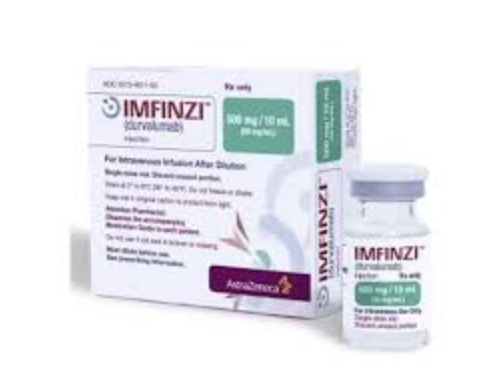
IMFINZI® (durvalumab) is a human monoclonal antibody that binds to the PD-L1 protein and blocks the interaction of PD-L1 with the PD-1 and CD80 proteins, countering the tumor’s immune-evading tactics and releasing the inhibition of immune responses.
AstraZeneca
AstraZeneca (LSE/STO/NYSE: AZN) is a global, science-led biopharmaceutical company that focuses on the discovery, development, and commercialization of prescription medicines in Oncology, Rare Diseases, and BioPharmaceuticals, including Cardiovascular, Renal & Metabolism, and Respiratory & Immunology. Based in Cambridge, UK, AstraZeneca’s innovative medicines are sold in more than 125 countries and used by millions of patients worldwide.
For more information Please visit www.astrazeneca-us.com