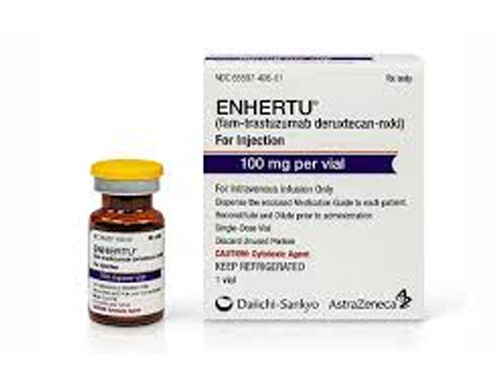
In the neoadjuvant setting, ENHERTU followed by a taxane, trastuzumab, and pertuzumab (THP) has been approved for the treatment of adult patients with HER2-positive Stage II or Stage III breast cancer. In the adjuvant setting, ENHERTU has been approved for the treatment of adult patients with HER2-positive breast cancer who have residual invasive disease following trastuzumab (with or without pertuzumab) and taxane-based treatment.
Shanu Modi, MD, Medical Oncologist, Memorial Sloan Kettering Cancer Center, said: “HER2-positive breast cancer is an aggressive disease, and our goal is to reduce the risk of recurrence for patients as early as possible to achieve the best long-term outcomes. The neoadjuvant setting offers the earliest opportunity to improve outcomes, while the adjuvant setting provides another important chance to prevent recurrence for patients with residual disease after surgery. These two new indications in HER2-positive early breast cancer will evolve how we treat patients in these settings and support trastuzumab deruxtecan as a potential new standard of care in early-stage disease.”
Dave Fredrickson, Executive Vice President, Oncology Haematology Business Unit, AstraZeneca, said: “HER2-positive early disease is considered highly curable, however up to one in four patients still experience disease recurrence, underscoring the need for new options in this setting. These approvals mark an important step forward, expanding the possibility of cure to more patients for the first time in many years and positioning ENHERTU as a foundational treatment in early breast cancer.”
Ken Keller, Global Head of Oncology Business, and President and CEO, Daiichi Sankyo, Inc. said: “ENHERTU has redefined the treatment of HER2-expressing breast cancer with practice-changing data across six breast cancer indications in seven years. ENHERTU is now approved in the US across both early and metastatic HER2-positive breast cancer, accomplishing what we set out to achieve a little over a decade ago for patients at the start of our comprehensive clinical development program.”
Victoria Smart, Senior Vice President, Mission, Susan G. Komen, said: “Providing patients with early breast cancer more options to help prevent progression to metastatic disease can lead to improved outcomes. Progression and recurrence remain among the most significant unmet needs for those diagnosed with early breast cancer, and continued advances in treatment bring new hope to patients and families facing this disease.”
In DESTINY-Breast11, ENHERTU followed by THP as a neoadjuvant treatment demonstrated a pathologic complete response (pCR) rate of 67.3% compared with 56.3% for dose-dense doxorubicin and cyclophosphamide followed by THP [ddAC-THP], an improvement of 11.2% (95% confidence interval [CI] 3.9-18.3; p=0.003). At the time of the pCR analysis, 29 patients (4.5%) had event-free survival (EFS) events, and 12 patients (1.9%) had overall survival (OS) events. The results were published in Annals of Oncology.1
In DESTINY-Breast05, ENHERTU as an adjuvant treatment reduced the risk of invasive disease recurrence or death (invasive disease-free survival [IDFS]) by 53% compared to trastuzumab emtansine (T-DM1) in patients with HER2-positive breast cancer with residual invasive disease following neoadjuvant therapy (hazard ratio [HR] 0.47; 95% CI 0.34-0.66; p<0.0001). At three years, 92.4% of patients in the ENHERTU arm were alive and free of invasive disease, compared with 83.7% of those in the T-DM1 arm, with 51 (6%) events in the ENHERTU arm and 102 (12%) in the T-DM1 arm. The results were published in The New England Journal of Medicine.2
Based on the DESTINY-Breast05 results, trastuzumab deruxtecan (ENHERTU) has been included in the NCCN Clinical Practice Guidelines in Oncology (NCCN Guidelines®) as a Category 1 recommended treatment in the adjuvant setting for patients with HER2-positive early breast cancer with residual disease and a high risk of recurrence following preoperative therapy. See NCCN Guidelines® for detailed recommendations.
No new safety concerns were identified with ENHERTU in the DESTINY-Breast11 or DESTINY-Breast05 trials.
In DESTINY-Breast11, ENHERTU followed by THP showed similar rates of drug-related overall adverse events (AEs) and interstitial lung disease (ILD)/pneumonitis as ddAC-THP, and lower rates of Grade 3 or higher AEs, serious AEs, AEs leading to treatment interruptions, left ventricular dysfunction and hematological toxicities.
In DESTINY-Breast05, ENHERTU and T-DM1 showed similar rates of overall drug-related AEs and Grade 3 or higher AEs. Adjudicated drug-related ILD/pneumonitis occurred in 9.6% of patients in the ENHERTU arm and 1.6% of patients in the T-DM1 arm. The majority of ILD/pneumonitis events were low grade in both arms. There were seven Grade 3 events and two deaths (Grade 5) in the ENHERTU arm.
The DESTINY-Breast11 and DESTINY-Breast05 US regulatory submissions were both reviewed under Project Orbis, which provides a framework for concurrent submission and review of oncology medicines among participating international partners. Separate regulatory applications for both trials are also under review in other countries. DESTINY-Breast05 previously received Priority Review and Breakthrough Therapy Designation by the FDA.
ENHERTU is already approved in more than 95 countries, including the US, as a treatment for patients with HER2-positive metastatic breast cancer.
ENHERTU is a specifically engineered HER2-directed DXd antibody drug conjugate (ADC) discovered by Daiichi Sankyo and being jointly developed and commercialized by AstraZeneca and Daiichi Sankyo.
Financial Considerations
Following these approvals in the US, an amount of $155 million is due from AstraZeneca to Daiichi Sankyo as milestone payments for both these indications. Sales of ENHERTU in the US are recognized by Daiichi Sankyo. For further details on the financial arrangements, please consult the collaboration agreement from March 2019.
Indications
ENHERTU is a HER2-directed antibody and topoisomerase inhibitor conjugate indicated for:
HER2-Positive Early Breast Cancer
- As neoadjuvant treatment of adult patients with HER2-positive (IHC 3+ or ISH+) Stage II or III breast cancer, as determined by an FDA-authorized test followed by a taxane, trastuzumab, and pertuzumab (THP)
- As adjuvant treatment of adult patients with HER2-positive (IHC 3+ or ISH+) breast cancer who have residual invasive disease following neoadjuvant trastuzumab (with or without pertuzumab) and taxane-based treatment
- HER2-Positive Metastatic Breast Cancer
- In combination with pertuzumab as first-line treatment of adult patients with unresectable or metastatic HER2-positive (IHC 3+ or ISH+) breast cancer, as determined by an FDA-authorized test
- As monotherapy for the treatment of adult patients with unresectable or metastatic HER2-positive (IHC 3+ or ISH+) breast cancer who have received a prior anti-HER2-based regimen either in the metastatic setting, or, in the neoadjuvant or adjuvant setting and have developed disease recurrence during or within six months of completing therapy
HER2-Low and HER2-Ultralow Metastatic Breast Cancer - As monotherapy for the treatment of adult patients with unresectable or metastatic hormone receptor (HR)-positive, HER2-low (IHC 1+ or IHC 2+/ISH-) or HER2-ultralow (IHC 0 with membrane staining) breast cancer, as determined by an FDA-authorized test, that has progressed on one or more endocrine therapies in the metastatic setting
- As monotherapy for the treatment of adult patients with unresectable or metastatic HER2-low (IHC 1+ or IHC 2+/ISH-) breast cancer, as determined by an FDA-authorized test, who have received a prior chemotherapy in the metastatic setting or developed disease recurrence during or within 6 months of completing adjuvant chemotherapy
- HER2-Mutant Unresectable or Metastatic Non-Small Cell Lung Cancer (NSCLC)
- As monotherapy for the treatment of adult patients with unresectable or metastatic NSCLC whose tumors have activating HER2 (ERBB2) mutations, as detected by an FDA-authorized test, and who have received a prior systemic therapy
This indication is approved under accelerated approval based on objective response rate and duration of response. Continued approval for this indication may be contingent upon verification and description of clinical benefit in a confirmatory trial.
HER2-Positive Locally Advanced or Metastatic Gastric Cancer
As monotherapy for the treatment of adult patients with locally advanced or metastatic HER2-positive (IHC 3+ or IHC 2+/ISH positive) gastric or gastroesophageal junction (GEJ) adenocarcinoma who have received a prior trastuzumab-based regimen
HER2-Positive (IHC 3+) Unresectable or Metastatic Solid Tumors
As monotherapy for the treatment of adult patients with unresectable or metastatic HER2-positive (IHC 3+) solid tumors who have received prior systemic treatment and have no satisfactory alternative treatment options
This indication is approved under accelerated approval based on objective response rate and duration of response. Continued approval for this indication may be contingent upon verification and description of clinical benefit in a confirmatory trial.
Embryo-Fetal Toxicity
ENHERTU can cause fetal harm when administered to a pregnant woman. Advise patients of the potential risks to a fetus. Verify the pregnancy status of females of reproductive potential prior to the initiation of ENHERTU. Advise females of reproductive potential to use effective contraception during treatment and for 7 months after the last dose of ENHERTU. Advise male patients with female partners of reproductive potential to use effective contraception during treatment with ENHERTU and for 4 months after the last dose of ENHERTU.
AstraZeneca in oncology
AstraZeneca is leading a revolution in oncology with the ambition to provide cures for cancer in every form, following the science to understand cancer and all its complexities to discover, develop and deliver life-changing medicines to patients.
The Company's focus is on some of the most challenging cancers. It is through persistent innovation that AstraZeneca has built one of the most diverse portfolios and pipelines in the industry, with the potential to catalyze changes in the practice of medicine and transform the patient experience.
AstraZeneca has the vision to redefine cancer care and, one day, eliminate cancer as a cause of death.
AstraZeneca
AstraZeneca (LSE/STO/NYSE: AZN) is a global, science-led biopharmaceutical company that focuses on the discovery, development, and commercialization of prescription medicines in Oncology, Rare Diseases, and BioPharmaceuticals, including Cardiovascular, Renal & Metabolism, and Respiratory & Immunology. Based in Cambridge, UK, AstraZeneca’s innovative medicines are sold in more than 125 countries and used by millions of patients worldwide.
For more information please visit, www.astrazeneca.com