The findings – presented at the 2026 American Urological Association (AUA) Annual Meeting and scheduled for publication in Translational Andrology and Urology later in May – reflect outcomes observed following a re-induction dose (second dose overall) of ADSTILADRIN in a real-world clinical setting, including two patients (2/13) with CIS with papillary disease (T1).1
ADSTILADRIN is the first and only non-replicating intravesical gene therapy approved by the U.S. Food and Drug Administration (FDA) for the treatment of patients with high-risk BCG-unresponsive NMIBC with CIS, with or without papillary tumors (±Ta/T1), and is administered once every three months.
“These findings offer a promising signal that some patients who do not achieve a complete response after an initial dose of ADSTILADRIN may still benefit from re-induction,” said Chad Reichard, MD, urologic oncologist and Director of Oncology at Urology of Indiana. “Real-world evidence provides important insight into how ADSTILADRIN is being used in routine clinical practice, and the responses observed in this study support the feasibility of re-induction as a potential option for certain patients despite an initial non-response, while highlighting the need for further study.”
The retrospective, observational cohort study analyzed electronic health record data from U.S. private urology practices. Thirteen patients with BCG‑unresponsive NMIBC were eligible, including eight with CIS alone, two with CIS and papillary disease (Ta), and three with CIS and papillary disease (T1). Patients had a mean age of 77.5 years; all were male and had received a mean of 11 prior BCG doses. Prior treatments included gemcitabine (n=4) and pembrolizumab (n=5). Median follow‑up following re‑induction was 379 days (range, 135–519). After re‑induction, four patients (30.8%) achieved a complete response, including two patients with CIS and T1 disease.
Among patients who achieved a complete response, three went on to receive additional doses of ADSTILADRIN; one patient has maintained a complete response at last follow‑up. One patient experienced progression to muscle‑invasive disease (T2a), and one patient underwent cystectomy approximately 51 weeks after initiation of therapy. At the time of analysis, no patient deaths had been reported.
“These new data add to the growing body of real-world evidence generated in urology practices and help inform how re-induction with ADSTILADRIN is being evaluated outside of the controlled clinical trial setting, particularly in a heavily pretreated patient population,” said Daniel Shoskes, MD, MSc, FRCS(C), Vice President, Global Medical Director Uro-Oncology, Ferring Pharmaceuticals. “In the Phase 2 and Phase 3 clinical trials, patients who did not achieve a complete response at three months were not retreated with ADSTILADRIN. However, re-induction is an approach that has been used with some immune-based therapies. These real‑world findings provide insight into how re-induction may improve complete response outcomes over the course of treatment.”
About Non-Muscle Invasive Bladder Cancer (NMIBC)
NMIBC is a form of bladder cancer that is found in the inner layer cells of the bladder and does not invade into or beyond the muscle wall.2 In the United States, bladder cancer is the sixth most common cancer,3 fourth among men,4 and it is estimated that there will be approximately 84,870 new cases of bladder cancer in the U.S. in 2025.4 Historically, 75% of bladder cancer presents as NMIBC.5 In patients with high-risk NMIBC, intravesical BCG remains the first-line standard-of-care; however, approximately one third of patients with NMIBC will not respond to BCG therapy and 50% of those with an initial response will experience recurrence or progression of their disease.6 Current treatment options for BCG-unresponsive patients are very limited and National Comprehensive Cancer Network (NCCN) guidelines recommend cystectomy (partial or complete removal of the bladder.
About ADSTILADRIN
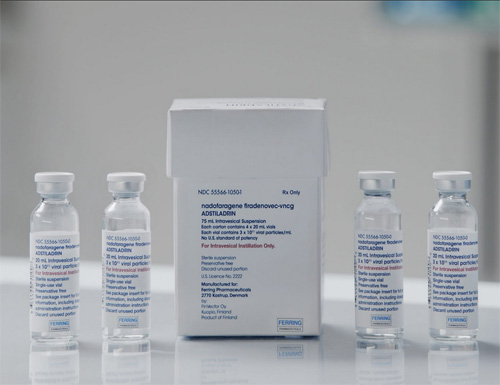
ADSTILADRIN® (nadofaragene firadenovec-vncg) is the first and only FDA-approved intravesical non-replicating gene-therapy for the treatment of adult patients with high-risk Bacillus Calmette-Guérin (BCG)-unresponsive non-muscle invasive bladder cancer (NMIBC) with carcinoma in situ (CIS) with or without papillary tumors (±Ta/T1). It is a non-replicating adenovirus vector-based therapy containing the gene interferon alfa-2b, administered locally as a monotherapy by catheter directly into the bladder once every three months. The vector enters the cells of the bladder wall, releasing the active gene and causing the bladder’s cell walls to secrete high and transient local expression of interferon alfa-2b protein, a naturally occurring protein the body uses to fight cancer. This approach essentially turns the bladder wall cells into interferon microfactories, enhancing the body’s own natural defenses against the cancer.
ADSTILADRIN has been studied in a clinical trial program that includes 157 patients with high-risk, BCG-unresponsive NMIBC, who had been treated with adequate BCG previously and did not see benefit from additional BCG treatment (full inclusion criteria published on clinicaltrials.gov: NCT02773849 and final five-year follow-up analysis published in The Journal of Urology).8-9
INDICATION
ADSTILADRIN is a non-replicating adenoviral vector-based gene therapy indicated for the treatment of adult patients with high-risk Bacillus Calmette-Guérin (BCG)-unresponsive non-muscle invasive bladder cancer (NMIBC) carcinoma in situ (CIS) with or without papillary tumors (±Ta/T1).
WARNINGS AND PRECAUTIONS:
Risk with delayed cystectomy: Delaying cystectomy in patients with BCG-unresponsive CIS could lead to development of muscle invasive or metastatic bladder cancer, which can be lethal. If patients with CIS do not have a complete response to treatment after 3 months or if CIS recurs, consider cystectomy.
Risk of disseminated adenovirus infection: Persons who are immunocompromised or immunodeficient may be at risk for disseminated infection from ADSTILADRIN due to low levels of replication-competent adenovirus. Avoid ADSTILADRIN exposure to immunocompromised or immunodeficient individuals.
DOSAGE AND ADMINISTRATION: Administer ADSTILADRIN by intravesical instillation only. ADSTILADRIN is not for intravenous use, topical use or oral administration.
USE IN SPECIFIC POPULATIONS: Advise females of reproductive potential to use effective contraception during ADSTILADRIN treatment and for 6 months after the last dose. Advise male patients with female partners of reproductive potential to use effective contraception during ADSTILADRIN treatment and for 3 months after the last dose.
ADVERSE REACTIONS: The most common (>10%) adverse reactions; including, laboratory abnormalities (>15%), were increased glucose, instillation site discharge, increased triglycerides, fatigue, bladder spasm, micturition (urination urgency), increased creatinine, hematuria (blood in urine), decreased phosphate, chills, pyrexia (fever) and dysuria (painful urination).
About Ferring Pharmaceuticals
Ferring Pharmaceuticals is a privately-owned, specialty, biopharmaceutical group committed to building families and helping people live better lives. In the United States, Ferring is a leader in reproductive medicine and in areas of gastroenterology and orthopaedics. We are at the forefront of innovation in microbiome-based therapeutics and uro-oncology intravesical gene therapy. Our company was founded in 1950 and is headquartered in Saint-Prex, Switzerland. Ferring employs more than 7,000 people worldwide and markets its medicines in over 100 countries. Ferring USA is based in Parsippany, New Jersey, and employs more than 900 employees.
For more information, please visit www.ferringusa.com