Tafa-Len-R-CHOP) versus R-CHOP, the current standard of care, as a first-line treatment for adults with previously untreated diffuse large B-cell lymphoma (DLBCL) or high-grade B-cell lymphoma (HGBL). Eligible patients had an International Prognostic Index (IPI) score of 3-5, or, for patients ≤60 years of age, an age-adjusted IPI (aaIPI) of 2-3.
These data are being highlighted in a prestigious Plenary Abstracts Session at the European Hematology Association (EHA) 2026 Congress, being held June 11 - 14, 2026, in Stockholm, Sweden (Abstract # S101. Plenary Abstract Session. June 13, 6:00 - 7:30 a.m. ET [12:00-1:30 p.m. CEST]). frontMIND results were also recently published in The Lancet.
“These frontMIND data reinforce the potential of Tafa-Len-R-CHOP to meaningfully change the first-line treatment landscape for patients with high-risk DLBCL or HGBL, for which outcomes have remained unchanged for decades,” said Steven Stein, M.D., Executive Vice President, Chief Medical Officer and Head of Late-stage Development, Incyte. “With encouraging efficacy observed across prespecified subgroups regardless of cell-of-origin (COO) molecular subtype, we believe these findings position this therapy as a compelling potential new standard of care and support our continued efforts to bring it to patients who are in need of other efficacious treatment options.”
The results, which build on previously reported topline data and also recently announced at the 2026 American Society of Clinical Oncology Annual Meeting, showed Tafa-Len-R-CHOP resulted in statistically significant and clinically meaningful improvements in progression-free survival (PFS).
Efficacy Data
- A 25% reduction in risk of disease progression or death demonstrated with Tafa-Len-R-CHOP compared with R-CHOP (HR 0.75 [P=0.0194]; 95% CI: 0.59, 0.96; median follow-up of 35.2 months).
- PFS increase of 8.2% at 2 years (71.1% with Tafa-Len-R-CHOP vs. 62.9% with R-CHOP) and a PFS increase of 6.6% at 3 years (67.3% with Tafa-Len-R-CHOP vs. 60.7% with R-CHOP).
- Tafa-Len-R-CHOP trends toward PFS advantage were broadly consistent across prespecified subgroups, including patients with centrally confirmed lymphoma subtypes and across COO molecular subtypes (ABC [Activated B-cell-like] and GCB [Germinal Center B-cell-like]).
- Tafa-Len-R-CHOP significantly improved event-free survival (EFS) compared to R-CHOP (HR 0.79 [P=0.0260] 95% CI: 0.64, 0.97; median follow-up of 35.4 months).
- Interim overall survival (OS) analysis demonstrated a positive trend toward improvement (HR=0.85 [P=0.2703] 95% CI: 0.63, 1.14, median follow-up of 35.9 months).
- Minimal residual disease (MRD)-negativity rate was 81.3% with Tafa-Len-R-CHOP and 66.7% with R-CHOP.
“A key goal in frontline treatment is to potentially prevent relapse, and spare patients from requiring additional therapies later. This is particularly meaningful for high-risk DLBCL and HGBL patients, where new treatment approaches are needed,” said Dr. Georg Lenz, University Hospital Münster and principal investigator of the frontMIND study. “The frontMIND results are especially encouraging because the addition of tafasitamab and lenalidomide improved outcomes without compromising delivery of the R-CHOP backbone, which remains fundamental to achieving better outcomes for patients.”
Safety Data
Tafa-Len-R-CHOP was generally well tolerated, and safety was consistent with the expected safety profile of adding Tafa-Len to R-CHOP. Safety findings included:
- The most common treatment-emergent adverse events (TEAEs) for Tafa-Len-R-CHOP were neutropenia (70.7%), anemia (46.3%) and peripheral neuropathy (40.6%).
- Any grade TEAEs were similar in both treatment arms (98.6% vs 97.1%).
- More Grade ≥3 TEAEs occurred with Tafa-Len-R-CHOP (86.7%) vs R-CHOP (76.1%).
- The most common Grade 3 TEAEs for Tafa-Len-R-CHOP group were anemia (22.8%), thrombocytopenia (13.1%) and neutropenia (12.4%) vs. anemia (15.9%), febrile neutropenia (8.7%) and thrombocytopenia (6.7%) for R-CHOP.
- Incremental safety events observed with Tafa-Len-R-CHOP were well managed and did not interfere with the delivery of the R-CHOP backbone.
- Rates of TEAEs leading to discontinuation of all study treatment were similar between the two groups (5.2% for Tafa-Len-R-CHOP and 5.4% for R‑CHOP) - a higher rate of fatal TEAEs was observed with Tafa-Len-R-CHOP (5.9% vs 3.8% with R-CHOP), however there were fewer overall deaths with Tafa-Len-R-CHOP (82 [18.5%]) compared to R-CHOP (97 [21.7%]), consistent with the positive trend observed in overall survival.
The frontMIND data support global regulatory applications for tafasitamab and lenalidomide in addition to R-CHOP for previously untreated DLBCL and HGBL.
About DLBCL
Diffuse large B-cell lymphoma (DLBCL) is the most common type of non-Hodgkin lymphoma (NHL) in adults worldwide, representing 40% of all cases.1 It is characterized as an aggressive, fast-growing type of lymphoma that can emerge in lymph nodes or extranodal sites such as the gastrointestinal tract, skin and brain.2 Each year, approximately 24,000 people in the U.S. and up to 36,000 people in Europe are diagnosed with DLBCL.3,4 With about 40% of these patients not responding to initial therapy or relapsing thereafter5,6, there is a high medical need for new, effective therapies, particularly for high-risk patients.
About frontMIND
The frontMIND trial (NCT04824092) is a randomized, double-blind, placebo-controlled, global Phase 3 study in patients with previously untreated high-risk diffuse large B-cell lymphoma (DLBCL) and high-grade B-cell lymphoma (HGBL).
The study enrolled 899 adults (≥18 to ≤80 years) and is evaluating the efficacy and safety of tafasitamab and lenalidomide added to R-CHOP (rituximab, cyclophosphamide, doxorubicin, vincristine and prednisone) compared with R-CHOP.
The primary endpoint of the study is investigator-assessed progression-free survival (PFS) using the Lugano 2014 criteria. Key secondary endpoints include event-free survival (EFS) by investigator assessment and overall survival (OS).
About Tafasitamab (Monjuvi®/Minjuvi®)
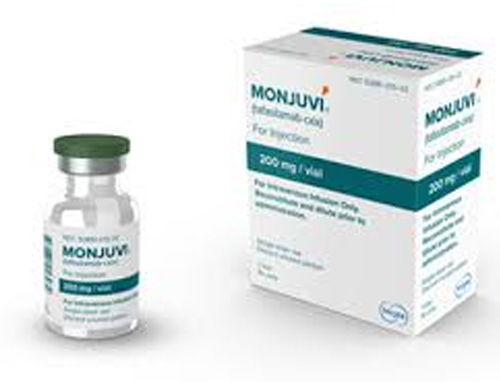
Tafasitamab (Monjuvi®/Minjuvi®) is a humanized Fc-modified cytolytic CD19-targeting monoclonal antibody. Tafasitamab incorporates an XmAb® engineered Fc domain, which mediates B-cell lysis through apoptosis and immune effector mechanism including Antibody-Dependent Cell-Mediated Cytotoxicity (ADCC) and Antibody-Dependent Cellular Phagocytosis (ADCP). Incyte licenses exclusive worldwide rights to develop and commercialize tafasitamab from Xencor, Inc.
In the U.S., Monjuvi® (tafasitamab-cxix) is approved by the U.S. Food and Drug Administration in combination with lenalidomide and rituximab for the treatment of adult patients with relapsed or refractory follicular lymphoma (FL). Additionally, Monjuvi received accelerated approval in the United States in combination with lenalidomide for the treatment of adult patients with relapsed or refractory diffuse large B-cell lymphoma (DLBCL) not otherwise specified, including DLBCL arising from low grade lymphoma, and who are not eligible for autologous stem cell transplant (ASCT).
Monjuvi is not indicated and is not recommended for the treatment of patients with relapsed or refractory marginal zone lymphoma outside of controlled clinical trials.
In Europe, Minjuvi® (tafasitamab) received conditional Marketing Authorization from the European Medicines Agency in combination with lenalidomide, followed by Minjuvi monotherapy, for the treatment of adult patients with relapsed or refractory DLBCL who are not eligible for ASCT. In addition, in December 2025, the EMA approved Minjuvi, in combination with lenalidomide and rituximab, for the treatment of adult patients with relapsed or refractory FL (Grade 1-3a) after at least one line of systemic therapy.
The most common side effects of MONJUVI include:
- Feeling tired or weak
- Diarrhea
- Cough
- Fever
- Swelling of lower legs or hands
- Respiratory tract infection
- Decreased appetite
These are not all the possible side effects of MONJUVI. Your healthcare provider will give you medicines before each infusion to decrease your chance of infusion reactions. If you do not have any reactions, your healthcare provider may decide that you do not need these medicines with later infusions. Your healthcare provider may need to delay or completely stop treatment with MONJUVI if you have severe side effects.
About Incyte®
Incyte is redefining what’s possible in biopharmaceutical innovation. Through deep scientific expertise and a relentless focus on patients, we have built an established portfolio of first-in-class medicines and an extensive portfolio of next-generation medicines across our key franchises: Hematology, Oncology and Inflammation & Autoimmunity.
For more information please visit, www.Incyte.com