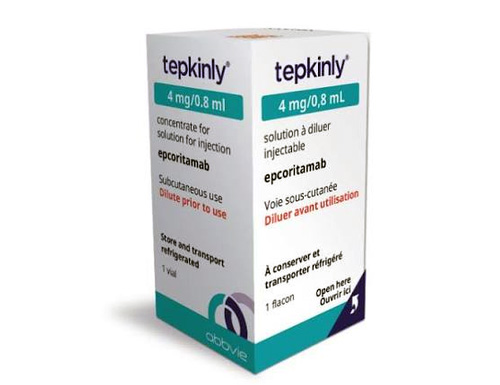
The approval is based on results from the pivotal Phase 3 EPCORE® FL-1 trial, which evaluated fixed-duration TEPKINLY in combination with R2 compared to standard of care R2.
"Follicular lymphoma is a persistent form of cancer that remains incurable, which means patients need more treatment options. Patients often relapse and experience shorter remissions and have fewer treatment options each time the disease returns," said Catherine Thieblemont, M.D., Ph.D., head of the hemato-oncology department, Paris Cité University, Hôpital Saint-Louis Assistance-Publique-Hopitaux de Paris (APHP) in Paris. "The results shown in the EPCORE FL-1 trial are clinically meaningful, demonstrating the potential for TEPKINLY + R2 to change the treatment paradigm for patients, offering the chance at a durable response with a chemotherapy-free option."
The marketing authorization is supported by data from the Phase 3 EPCORE FL-1 trial, an open-label interventional trial to evaluate the safety and efficacy of TEPKINLY + R2 compared to R2 alone in patients with R/R FL. The study demonstrated TEPKINLY + R2 reduced the risk of disease progression or death by 79% (HR 0.21, 95% CI: 0.13 - 0.33, p<0.0001) compared to R2 alone. The overall response rate (ORR) in patients treated with TEPKINLY + R2 was 96% (95% CI: 90.2, 98.6) compared to 81% in patients treated with R2 (95% CI: 72.7, 87.7; p<.0001). Among patients who were treated with TEPKINLY + R2, 74% achieved a complete response (CR) (n=181/243, 95% CI: 68.5, 79.8) compared to a 43% CR rate among patients treated with R2 (n=106/245, 95% CI: 37.0, 49.7).
The safety profile of TEPKINLY + R2 in the EPCORE FL-1 study was consistent with the known safety profiles of the individual regimens (epcoritamab and R2). In the trial, the most common (≥ 20%) adverse reactions were neutropenia, rash, upper respiratory tract infections, fatigue, diarrhea, injection site reactions, anemia, constipation, thrombocytopenia, cytokine release syndrome (CRS), hypogammaglobulinemia, COVID-19, pyrexia, and pneumonia. Serious adverse reactions occurred in 44% of patients who received epcoritamab in combination with lenalidomide and rituximab. Serious adverse reactions in ≥ 5% of patients included CRS, pneumonia, COVID-19, and febrile neutropenia.
"There remains a critical need for new treatment options to improve outcomes for patients with relapsed or refractory follicular lymphoma, particularly in earlier lines of therapy," said Roopal Thakkar, M.D., executive vice president, research and development, chief scientific officer, AbbVie. "This approval is important because it brings an effective treatment option to patients across Europe, representing meaningful progress for patients with follicular lymphoma."
FL is typically a slow-growing form of non-Hodgkin lymphoma (NHL) that arises from B-cell lymphocytes. FL is the second most common form of NHL overall, accounting for 20-30 percent of all NHL cases.1 FL incidence is significantly higher in European populations, 11-29 percent, compared to non-European populations, 2-18 percent.2 FL is considered incurable, and there is no standard of care treatment for third-line or later FL.1,3 Patients who achieve remission also often experience relapse.4,5,6
"A diagnosis of follicular lymphoma can bring a relentless cycle of disease recurrence and treatment," said Mitchell Smith, M.D., Ph.D., Chief Medical Officer of the Follicular Lymphoma Foundation. "The approval of epcoritamab now in combination with R2 in Europe is a welcome advance that will bring an innovative treatment option and hope to the follicular lymphoma community."
About the EPCORE® FL-1 Trial
EPCORE FL-1 (NCT05409066) is a Phase 3 open-label interventional trial to evaluate the safety and efficacy of epcoritamab plus lenalidomide and rituximab (R2) versus R2 alone in patients with relapsed/refractory (R/R) follicular lymphoma (FL). The Phase 3 EPCORE FL-1 study included patients with relapsed or recurrent FL following at least one prior line of treatment across a broad range of patient characteristics and disease risk factors. Patients were randomized to receive epcoritamab in combination with R2 (n=243) or R2 alone (n=245). Patients received epcoritamab in 28-day cycles for a total of 12 cycles or until disease progression or unacceptable toxicity, whichever occurred first. Efficacy was established based on the dual primary endpoints of progression free survival (PFS) and overall response rate (ORR) determined by Lugano 2014 criteria as assessed by Independent Review Committee (IRC). Additional efficacy outcome measures include complete response (CR) and duration of response (DOR). The pivotal Phase 3 EPCORE FL-1 trial results were published in The Lancet in January 2026.
About Epcoritamab
Epcoritamab is an IgG1-bispecific antibody created using Genmab's proprietary DuoBody® technology and administered subcutaneously. Genmab's DuoBody-CD3 technology is designed to direct cytotoxic T cells selectively to elicit an immune response toward target cell types. Epcoritamab is designed to simultaneously bind to CD3 on T cells and CD20 on B cells and induces T-cell-mediated killing of CD20+ cells.6
Epcoritamab (approved under the brand name EPKINLY® in the U.S. and Japan, and TEPKINLY® in the European Union) has received regulatory approval in certain lymphoma indications in more than 65 territories. Epcoritamab is being co-developed by AbbVie and Genmab as part of the companies' oncology collaboration. The companies share commercial responsibilities in the U.S. and Japan, with AbbVie responsible for further global commercialization. Both companies will pursue additional international regulatory approvals for the investigational relapsed or refractory (R/R) follicular lymphoma (FL) indication and additional approvals for the R/R diffuse large B-cell lymphoma (DLBCL) indication.
AbbVie and Genmab continue to evaluate the use of epcoritamab as a monotherapy, and in combination, across lines of therapy in a range of hematologic malignancies. This includes several Phase 3, open-label, randomized trials, including a trial evaluating epcoritamab in combination with R-CHOP in adult patients with newly diagnosed DLBCL (NCT05578976), a trial evaluating epcoritamab in combination with lenalidomide compared to chemotherapy infusion in patients with R/R DLBCL (NCT06508658), and a trial evaluating epcoritamab in combination with lenalidomide and rituximab (R2) compared to chemoimmunotherapy in patients with previously untreated FL (NCT06191744). The safety and efficacy of epcoritamab has not been established for these investigational uses.
For more information Please visit www.clinicaltrials.gov