These data build upon previously reported one-year results and were presented at the American Association of Clinical Endocrinology 2026 Annual Meeting in Las Vegas.
Chronic exposure to supraphysiologic GC doses is associated with cardiometabolic comorbidities, bone density reductions, mental health issues and other long-term health risks that contribute to the cumulative treatment burden faced by patients over their lifetimes. Reducing high-dose, long-term GC exposure represents one of the most important goals in the management of classic congenital adrenal hyperplasia (CAH).
"For decades, the management of classic congenital adrenal hyperplasia has relied exclusively on supraphysiologic glucocorticoid dosing to control adrenal androgen and adrenocorticotropic hormone excess, exposing patients to significant cumulative long‑term risks," said Sanjay Keswani, M.D., Chief Medical Officer, Neurocrine Biosciences. "These two‑year findings demonstrated that CRENESSITY provided durable androgen control while enabling meaningful reductions in glucocorticoid exposure. Importantly, these reductions were sustained over time without new safety or tolerability concerns, supporting CRENESSITY as a long‑term treatment option that advances the standard of care for people living with this complex condition."
At Month 24 of the study, 69% (103/149) of participants achieved a physiologic GC dose (≤11 mg/m2/day hydrocortisone equivalents), with many participants eliminating nonphysiologic GC types. Of participants originally taking dexamethasone (n=20), 75% switched to a dexamethasone-free regimen, while 62% (37/60) of patients taking more than two doses of hydrocortisone per day were able to eliminate a dose outright. GC dose reductions and regimen changes were achieved without worsening androstenedione levels relative to baseline, indicating that lowering the GC dose was not achieved at the expense of androgen control.
Long‑term treatment with CRENESSITY was generally well tolerated, with more than 80% study retention at two years and no new safety signals observed.
"Many years of supraphysiologic glucocorticoid exposure increase the risk for long-term health consequences, which include obesity, diabetes, reduced bone density and psychosocial struggles," said Richard J. Auchus, M.D., Ph.D., Professor of Internal Medicine and Pharmacology, University of Michigan Medical School and Principal Investigator for the CAHtalyst Adult study. "These sequelae significantly impact quality of life and commonly develop with traditional CAH treatment regimens. The two-year findings provide important information on the durable benefit of treatment with CRENESSITY. Providers can confidently incorporate this additional knowledge to guide their management of adult patients with CAH into the future."
Neurocrine will be sharing additional two-year data across clinical endpoints and outcomes at upcoming medical meetings.
Additional presentation at the American Association of Clinical Endocrinology 2026 Annual Meeting includes:
Cardiometabolic Outcomes Associated with Chronic Supraphysiologic Glucocorticoid Exposure and Crinecerfont Treatment: 1-Year Results from CAHtalyst Adult
About Congenital Adrenal Hyperplasia
Congenital adrenal hyperplasia (CAH) is a rare genetic condition that results in an enzyme deficiency that alters the production of adrenal steroid hormones, such as cortisol, aldosterone and adrenal androgens. Severe enzyme deficiency leads to an inability of the adrenal glands to produce enough cortisol and, in approximately 75% of cases, aldosterone. Because individuals with CAH are typically still able to produce androgens, the unused precursors that would normally be used to make cortisol instead result in the production of excess amounts of androgens. If left untreated, CAH can result in adrenal crisis and even death.
Exogenous glucocorticoids (GCs) are necessary to correct the endogenous cortisol deficiency, but historically, doses higher than those needed for cortisol replacement (supraphysiologic) have been used to lower the elevated levels of adrenocorticotropic hormone (ACTH) and adrenal androgens. However, GC treatment at supraphysiologic doses has been associated with serious and significant complications of steroid excess, including metabolic issues such as weight gain and diabetes, cardiovascular disease and osteoporosis. Additionally, long-term treatment with supraphysiologic GCs may have psychological and cognitive impacts, such as changes in mood and memory. Adrenal androgen excess has been associated with abnormal bone growth and development in pediatric patients, female health problems such as excess facial hair growth and menstrual irregularities, in addition to cardiometabolic and fertility issues in both sexes. The symptoms of high ACTH may include testicular adrenal rest tumors (TARTs).
About CRENESSITY® (crinecerfont)
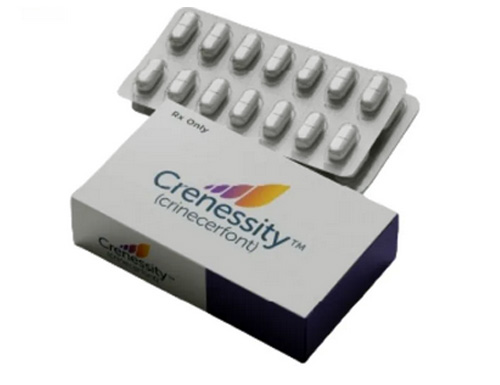
CRENESSITY is a potent and selective oral corticotropin-releasing factor type 1 receptor (CRF1) antagonist that reduces and controls excess adrenocorticotropic hormone (ACTH) and adrenal androgens through a non-glucocorticoid (GC) mechanism for the treatment of classic congenital adrenal hyperplasia (CAH). Antagonism of CRF1 receptors in the pituitary has been shown to decrease ACTH levels, which in turn decreases the production of adrenal androgens and potentially the symptoms associated with CAH. The robust clinical study data demonstrate that lowering adrenal androgen levels with CRENESSITY enables lower, more physiologic dosing of GCs to replace missing cortisol.
CRENESSITY comes in capsules and an oral solution. For adults 18 years of age and older, the recommended dosage is 100 mg twice daily taken orally with a meal. For pediatric patients four to 17 years of age weighing less than 55 kg (121 lbs), the recommended dosage is based on body weight and is administered twice daily, taken orally with a meal. For pediatric patients weighing more than 55 kg (121 lbs), the recommended dosage is 100 mg twice daily taken orally with a meal. Healthcare providers can work with patients to determine the appropriate formulation for use depending on patient needs. Patients receiving CRENESSITY should continue GC therapy for cortisol replacement.
About The CAHtalyst® Studies
The Phase 3 CAHtalyst global registrational studies were designed to evaluate the safety, efficacy and tolerability of CRENESSITY® in children and adults with classic congenital adrenal hyperplasia (CAH) due to 21-hydroxylase deficiency. The CAHtalyst studies were the largest-ever clinical trial program in classic CAH, including 285 pediatric and adult patients.
The CAHtalyst Pediatric study included 103 pediatric patients four to 17 years of age. The study tested two questions. The first question evaluated whether four weeks of CRENESSITY treatment could improve androgen control. The second question evaluated whether an additional 24 weeks of CRENESSITY treatment enabled customized glucocorticoid (GC) down-titration while androstenedione levels were maintained or improved.
The CAHtalyst Adult study included 182 adult patients 18 to 58 years of age. Similarly, the first question of the study evaluated whether four weeks of CRENESSITY treatment could improve androgen control, and the second question evaluated whether an additional 20 weeks of CRENESSITY treatment enabled GC reduction to physiologic range while androstenedione levels were maintained or improved.
Data from the CAHtalyst Phase 3 studies supported approval of CRENESSITY by the U.S. Food and Drug Administration in December 2024. The open-label extension treatment portions of both studies are ongoing.
Important Information
Approved Uses
CRENESSITY® (crinecerfont) is a prescription medicine used together with glucocorticoids (steroids) to control androgen (testosterone-like hormone) levels in adults and children 4 years of age and older with classic congenital adrenal hyperplasia (CAH).
IMPORTANT SAFETY INFORMATION
Do not take CRENESSITY if you:
Are allergic to crinecerfont, or any of the ingredients in CRENESSITY.
CRENESSITY may cause serious side effects, including:
Allergic reactions. Symptoms of an allergic reaction include tightness of the throat, trouble breathing or swallowing, swelling of the lips, tongue, or face, and rash. If you have an allergic reaction to CRENESSITY, get emergency medical help right away and stop taking CRENESSITY.
Risk of Sudden Adrenal Insufficiency or Adrenal Crisis with Too Little Glucocorticoid (Steroid) Medicine. Sudden adrenal insufficiency or adrenal crisis can happen in people with congenital adrenal hyperplasia who are not taking enough glucocorticoid (steroid) medicine. You should continue taking your glucocorticoid (steroid) medicine during treatment with CRENESSITY. Certain conditions such as infection, severe injury, or shock may increase your risk for sudden adrenal insufficiency or adrenal crisis. Tell your healthcare provider if you get a severe injury, infection, illness, or have planned surgery during treatment. Your healthcare provider may need to change your dose of glucocorticoid (steroid) medicine.
About Neurocrine Biosciences, Inc.
Neurocrine Biosciences is a leading biopharmaceutical company with a simple purpose: to relieve suffering for people with great needs. We are dedicated to discovering and developing life-changing treatments for patients with under-addressed neurological, endocrine, psychiatric and immunological disorders. The company's diverse portfolio includes FDA-approved treatments for tardive dyskinesia, chorea associated with Huntington's disease, classic congenital adrenal hyperplasia, endometriosis* and uterine fibroids,* as well as a robust pipeline including multiple compounds in mid- to late-phase clinical development across our core therapeutic areas. For three decades, we have applied our unique insight into neuroscience and the interconnections between brain and body systems to treat complex conditions. We relentlessly pursue medicines to ease the burden of debilitating diseases and disorders because you deserve brave science.
For more information, please visit www.neurocrine.com,