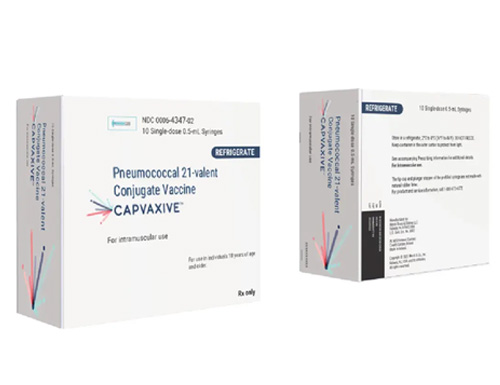
CAPVAXIVE is indicated for:
Active immunization for the prevention of invasive pneumococcal disease caused by Streptococcus pneumoniae serotypes 3, 6A, 7F, 8, 9N, 10A, 11A, 12F, 15A, 15B, 15C, 16F, 17F, 19A, 20A, 22F, 23A, 23B, 24F, 31, 33F and 35B in individuals 18 years of age and older and individuals 2 through 17 years of age who are at increased risk for pneumococcal disease;
Active immunization for the prevention of pneumonia caused by S. pneumoniae serotypes 3, 6A, 7F, 8, 9N, 10A, 11A, 12F, 15A, 15C, 16F, 17F, 19A, 20A, 22F, 23A, 23B, 24F, 31, 33F and 35B in individuals 18 years of age and older.
CAPVAXIVE should not be administered to individuals with a history of a severe allergic reaction (e.g., anaphylaxis) to any component of CAPVAXIVE or to diphtheria toxoid; see additional Select Safety Information below.
The indication for the prevention of pneumonia caused by S. pneumoniae serotypes 3, 6A, 7F, 8, 9N, 10A, 11A, 12F, 15A, 15C, 16F, 17F, 19A, 20A, 22F, 23A, 23B, 24F, 31, 33F, and 35B is approved under accelerated approval based on immune responses as measured by opsonophagocytic activity (OPA). Continued approval for this indication may be contingent upon verification and description of clinical benefit in a confirmatory trial.
“Children and adolescents with certain chronic conditions are at an increased risk for pneumococcal disease, including pneumonia, meningitis, and bloodstream infections,” said Dr. Rotem Lapidot, Chief of Pediatric Infectious Diseases at Rambam Health Care Campus, investigator, STRIDE-13 trial. “This approval recognizes the potential of CAPVAXIVE to deliver additional protection by including serotypes not contained in approved primary pediatric PCV series, and represents a new approach to helping protect children and adolescents at increased risk for pneumococcal disease.”
The approval is based on data from the Phase 3 STRIDE-13 trial, which evaluated CAPVAXIVE compared to PPSV23 (pneumococcal 23-valent polysaccharide vaccine) in children and adolescents aged 2 through 17 years who completed a primary pediatric pneumococcal vaccination series and have one or more chronic medical conditions that put them at an increased risk of pneumococcal disease. See “STRIDE-13 Clinical Data Supporting Approval” below for additional details.
“While CAPVAXIVE was specifically designed for adults, it may also offer additional disease protection for this specific population of children and adolescents, when given after the primary pediatric pneumococcal vaccination series,” said Dr. Paula Annunziato, senior vice president, infectious diseases and vaccines, global clinical development, Merck Research Laboratories. “The approval of CAPVAXIVE for children and adolescents at increased risk for pneumococcal disease demonstrates our commitment to addressing this disease in people of all ages, not only addressing an unmet need, but also reinforcing Merck’s longstanding commitment to public health and infectious diseases.”
The expanded indication for CAPVAXIVE complements existing primary pediatric pneumococcal vaccination series for children and adolescents at increased risk for pneumococcal disease. According to a 2025 study of 2015-2019 CDC ABC surveillance data, including three groups, one of which consisted of children <18 years old (age range 31 to 109 months; n=219) with at least one risk condition for invasive pneumococcal disease (IPD) such as chronic heart disease, chronic lung disease, diabetes, and chronic kidney disease, CAPVAXIVE covers the serotypes responsible for ~79% of IPD cases. In this risk group, the 11 unique serotypes covered by CAPVAXIVE account for ~40% of IPD cases. These values are based on CDC epidemiologic data and do not reflect the efficacy of CAPVAXIVE. There are currently no studies evaluating the efficacy of CAPVAXIVE.
About CAPVAXIVE
CAPVAXIVE is Merck’s 21-valent pneumococcal conjugate vaccine indicated for active immunization for the prevention of invasive disease and pneumonia in adults 18 years of age and older and for the prevention of invasive disease in children and adolescents aged 2 through 17 years who have one or more chronic medical conditions that put them at an increased risk of pneumococcal disease. CAPVAXIVE was specifically designed to help address the Streptococcus pneumoniae serotypes predominantly responsible for IPD in adults, including eight unique serotypes, 15A, 15C, 16F, 23A, 23B, 24F, 31 and 35B compared to other approved pneumococcal vaccines. CAPVAXIVE is administered as a single dose.
CAPVAXIVE helps provide coverage against the serotypes responsible for approximately 82% of IPD cases in adults 50 years of age and older, compared to ~54% by PCV20, based on national-level CDC data from 2019-2023. These values are based on CDC epidemiologic data and do not reflect the efficacy of the respective vaccines. There are currently no studies comparing the efficacy of CAPVAXIVE and PCV20.
With this approval, CAPVAXIVE is also indicated for the prevention of invasive disease in children and adolescents aged 2 through 17 years who have one or more chronic medical conditions that put them at an increased risk for pneumococcal disease.
STRIDE-13 Clinical Data Supporting Approval
STRIDE-13 (NCT06177912) is a randomized, double-blind, active comparator-controlled Phase 3 study that evaluated individuals 2 through 17 years of age with one or more prespecified medical conditions (diabetes mellitus, chronic heart disease, chronic kidney disease, chronic liver disease, chronic lung disease) known to increase the risk of pneumococcal disease and who have previously completed a primary pneumococcal vaccination regimen at least 8 weeks prior to enrollment (n=874). Participants were randomized 3:2 to receive a single dose of CAPVAXIVE (n=527) or PPSV23 (n=347).
- CAPVAXIVE was noninferior to PPSV23 for the 12 shared serotypes and induced statistically significantly greater OPA GMTs compared to PPSV23 for the 9 serotypes unique to CAPVAXIVE;
- CAPVAXIVE also elicited immune responses to serotype 15B (cross-reactive to serotype 15C). In a post hoc analysis utilizing the same prespecified noninferiority criterion that was used for the shared serotypes, CAPVAXIVE was noninferior to PPSV23 for serotype 15B;
- The safety profile of CAPVAXIVE was generally comparable to PPSV23. Solicited adverse reactions following administration of CAPVAXIVE lasted a median of 2 days with most reactions lasting ≤3 days;
- The proportion of individuals reporting 1 or more serious adverse events (SAE) within 6 months postvaccination was 5.5% (n=29) in individuals vaccinated with CAPVAXIVE and 7.2% (n=25) in individuals vaccinated with PPSV23. There were no notable patterns or imbalances between vaccine groups for SAEs. One individual (0.2%) who received CAPVAXIVE had an SAE considered related to vaccination. This SAE was syncope (Grade 2, required hospitalization) and occurred approximately 3 minutes postvaccination.
About Pneumococcal Disease
Pneumococcal disease is an infection caused by bacteria called Streptococcus pneumoniae. There are about 100 different types (referred to as serotypes) of pneumococcal bacteria, which can affect adults differently than children. Pneumococcal disease can be invasive or non-invasive. Non-invasive pneumococcal illnesses include pneumonia (when pneumococcal disease is confined to the lungs), whereas invasive pneumococcal illnesses include pneumococcal bacteremia (infection in the bloodstream), bacteremic pneumococcal pneumonia (pneumonia with bacteremia) and pneumococcal meningitis (infection of the coverings of the brain and spinal cord).
About Merck
At Merck, known as MSD outside of the United States and Canada, we are unified around our purpose: We use the power of leading-edge science to save and improve lives around the world. For more than 130 years, we have brought hope to humanity through the development of important medicines and vaccines. We aspire to be the premier research-intensive biopharmaceutical company in the world – and today, we are at the forefront of research to deliver innovative health solutions that advance the prevention and treatment of diseases in people and animals. We foster a diverse and inclusive global workforce and operate responsibly every day to enable a safe, sustainable and healthy future for all people and communities.
For more information, please visit www.merck.com