"Crohn's disease is a chronic inflammatory condition that affects an estimated 1 million Americans, and its impact often reaches beyond the gut as its unpredictability can impact daily life and emotional health for patients," said Kori Wallace, M.D., Ph.D., vice president, global head of immunology clinical development, AbbVie. "AbbVie continues to invest in research and innovative solutions to help elevate the standard of care for patients so that they may live a life unburdened by their Crohn's disease."
The application to the FDA is supported by the recently shared positive data from the Phase 3 AFFIRM study1 (NCT06063967), which evaluated the efficacy and safety of risankizumab SC as an induction treatment in adult patients with moderately to severely active CD, including both those with and without prior advanced therapy failure.
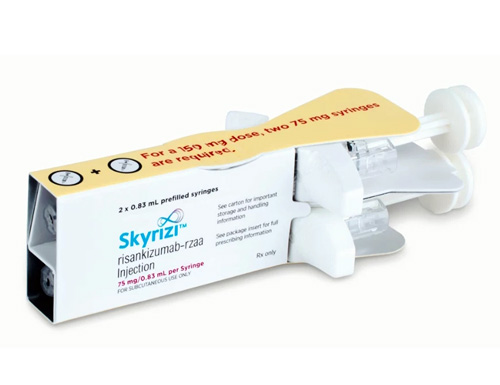
In 2022, SKYRIZI became the first interleukin-23 (IL-23) specific inhibitor approved by the FDA to treat adults with moderately to severely active CD. AbbVie anticipates FDA approval for this new dosing regimen for SKYRIZI later this year. If approved, patients with moderately to severely active CD would have a choice to receive their SKYRIZI induction via SC injection or through IV infusion and then continue subcutaneous maintenance dosing every eight weeks.
About Crohn's Disease
Crohn's disease is a chronic, systemic disease that manifests as inflammation within the gastrointestinal tract, most commonly in the area between the small intestine (ileum) and the colon, causing persistent diarrhea and abdominal pain.2,3 It is a progressive disease, meaning it gets worse over time and may lead to life-threatening complications or surgery.4,5 Because the signs and symptoms of Crohn's disease are unpredictable, it causes a significant burden on people living with the disease—not only physically but also emotionally and economically.6
About the AFFIRM Study
AFFIRM is a global, Phase 3, randomized, placebo-controlled, double-blind study to evaluate the efficacy and safety of risankizumab subcutaneous (SC) as an induction treatment in adult patients with moderately to severely active Crohn's disease. Co-primary endpoints were achievement of CDAI Clinical Remission (CDAI < 150) and achievement of endoscopic response at week 12. A total of 289 patients were randomized in a 2:1 ratio to risankizumab SC or placebo. Key demographics and baseline characteristics were generally balanced between the risankizumab SC and placebo groups; 65% had previously failed advanced therapies for the treatment of CD. The study consists of three treatment periods: a placebo-controlled Period A (baseline to week 12) to evaluate the efficacy and safety of risankizumab SC induction treatment, an extended Period B (week 12 to 24) where patients receive blinded or open-label treatments based on their clinical response at week 12, and a 52-week open-label extension Period C where all patients receive the approved risankizumab maintenance treatment.
About SKYRIZI® (risankizumab-rzaa)
SKYRIZI is an interleukin (IL)-23 inhibitor that selectively blocks IL-23 by binding to its p19 subunit. IL-23, a cytokine involved in inflammatory processes, is thought to be linked to a number of chronic immune-mediated diseases.8 SKYRIZI is approved by the U.S. Food and Drug Administration and the European Medicines Agency for the treatment of plaque psoriasis, psoriatic arthritis, Crohn's disease and ulcerative colitis.8,9
U.S. Indications and Important Safety Information about SKYRIZI® (risankizumab-rzaa)8
SKYRIZI is a prescription medicine used to treat adults with:
moderate to severe plaque psoriasis who may benefit from taking injections or pills (systemic therapy) or treatment using ultraviolet or UV light (phototherapy).
active psoriatic arthritis.
moderate to severe Crohn's disease.
moderate to severe ulcerative colitis.
IMPORTANT SAFETY INFORMATION
What is the most important information I should know about SKYRIZI® (risankizumab-rzaa)?
SKYRIZI is a prescription medicine that may cause serious side effects, including:
Serious allergic reactions:
Stop using SKYRIZI and get emergency medical help right away if you get any of the following symptoms of a serious allergic reaction:
Infections:
SKYRIZI may lower the ability of your immune system to fight infections and may increase your risk of infections. Your healthcare provider should check you for infections and tuberculosis (TB) before starting treatment with SKYRIZI and may treat you for TB before you begin treatment with SKYRIZI if you have a history of TB or have active TB. Your healthcare provider should watch you closely for signs and symptoms of TB during and after treatment with SKYRIZI.
What are the possible side effects of SKYRIZI?
SKYRIZI may cause serious side effects. See "What is the most important information I should know about SKYRIZI?"
Liver problems may happen while being treated for Crohn's disease or ulcerative colitis: A person with Crohn's disease who received SKYRIZI through a vein in the arm developed changes in liver blood tests with a rash that led to hospitalization. Your healthcare provider will do blood tests to check your liver before, during, and at least up to 12 weeks of treatment, and may stop treatment with SKYRIZI if you develop liver problems. Tell your healthcare provider right away if you notice any of the following symptoms: unexplained rash, nausea, vomiting, stomach (abdominal) pain, tiredness (fatigue), loss of appetite, yellowing of the skin and eyes (jaundice), and dark urine.
The most common side effects of SKYRIZI in people treated for Crohn's disease and ulcerative colitis include: upper respiratory infections, headache, joint pain, stomach (abdominal) pain, injection site reactions, low red blood cells (anemia), fever, back pain, urinary tract infection, and rash.
The most common side effects of SKYRIZI in people treated for plaque psoriasis and psoriatic arthritis include: upper respiratory infections, headache, feeling tired, injection site reactions, and fungal skin infections.
These are not all the possible side effects of SKYRIZI. Call your doctor for medical advice about side effects.
Use SKYRIZI exactly as your healthcare provider tells you to use it.
SKYRIZI (risankizumab-rzaa) is available in a 150 mg/mL prefilled syringe and pen, a 600 mg/10 mL vial for intravenous infusion, and a 180 mg/1.2 mL or 360 mg/2.4 mL single-dose prefilled cartridge with on-body injector.
About AbbVie
AbbVie's mission is to discover and deliver innovative medicines and solutions that solve serious health issues today and address the medical challenges of tomorrow. We strive to have a remarkable impact on people's lives across several key therapeutic areas including immunology, neuroscience and oncology – and products and services in our Allergan Aesthetics portfolio.
For more information please visit, www.abbvie.com